


Words never say only one thing. Every word carries a dictionary meaning, and most words also carry a feeling attached to that meaning. That feeling is what we call connotative meaning, and it shapes how readers, listeners, and even search engines interpret language.
Connotative meaning is the emotional or cultural association a word carries beyond its dictionary definition. It is the feeling, judgment, or image a word creates in a reader’s mind. For example, “childish” and “youthful” both relate to age, but one feels negative and the other feels positive.
Entity of the Word
Connotative meaning belongs to the field of semantics, the study of meaning in language. It works alongside denotation, tone, diction, and context. Writers, teachers, marketers, and speakers all use it daily, often without naming it.
What Is Connotative Meaning?

Connotative Meaning (Simple Definition)
Connotative meaning is what a word suggests or implies, separate from its literal definition. It is built from culture, personal experience, and common usage.
What Does “Connotative” Mean?
“Connotative” is the adjective form of connotation. A connotative word is one that carries an extra emotional layer alongside its dictionary sense.
Connotative Meaning Definition (Clear + School-Friendly)
Definition of Connotative Meaning
Connotative meaning is the implied or suggested meaning of a word, formed by emotion, association, and context, rather than its strict dictionary entry.
Simple Example
The word “snake” denotatively means a legless reptile. Connotatively, it often suggests someone who is untrustworthy or deceptive.
Click Here To Read Another Topic
Denotative and Connotative Meaning (The Big Difference)
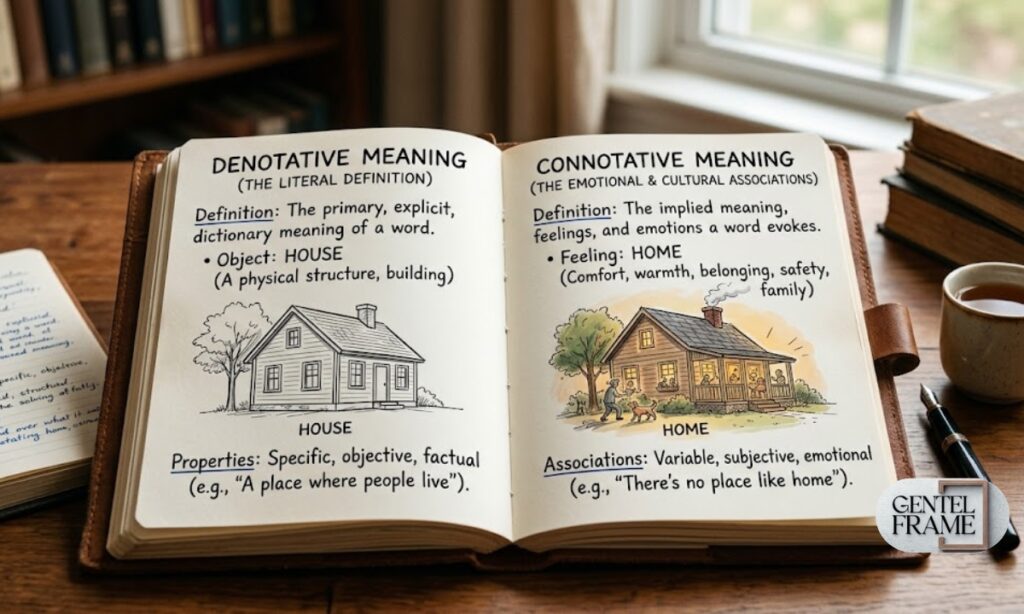
Denotative Meaning (Literal)
Denotative meaning is the exact, factual definition found in a dictionary. It does not change based on feeling or situation.
Connotative Meaning (Implied)
Connotative meaning shifts depending on tone, culture, and context. The same word can feel different in different sentences.
Why This Matters
Choosing the wrong word can change how a sentence is received, even if the literal meaning stays the same. This is why word choice matters so much in writing, speaking, and branding.
Denotative vs Connotative Meaning Table
| Aspect | Denotative Meaning | Connotative Meaning |
| Definition | Literal dictionary meaning | Emotional or cultural meaning |
| Changes with context | Rarely | Often |
| Source | Dictionaries | Culture, experience, usage |
| Example word | Home (a place to live) | Home (comfort, belonging) |
| Used in | Formal, technical writing | Poetry, marketing, speech |
What Is the Connotative Meaning of a Word?
Answer
The connotative meaning of a word is the feeling or idea it triggers beyond its plain definition. It depends on how the word is normally used in real conversation, not just how it is defined.
Types of Connotation: Positive, Negative, Neutral
Positive Connotation
A positive connotation creates a good, warm, or approving feeling. Example: “confident” suggests strength and self-belief.
Negative Connotation
A negative connotation creates a critical or unpleasant feeling. Example: “arrogant” suggests overconfidence in a negative way.
Neutral Connotation
A neutral connotation carries no strong emotional charge. Example: “car” simply names a vehicle without judgment.
Why Connotative Meaning Matters
It Changes How People Feel
The same fact can sound comforting or alarming depending on word choice.
It Affects Relationships
Calling someone “curious” instead of “nosy” changes how they receive the comment.
It Improves Writing
Skilled writers choose words for the mood they create, not only for accuracy.
It Matters in Marketing and Advertising
Brands choose words like “premium” over “expensive” to shape perception.
It’s Key in Communication
Misreading connotations is a common cause of misunderstandings between speakers.
Connotative Meaning in Communication

What it means
In everyday communication, connotation often carries more weight than denotation. People react to how something is said, not only what is said.
Example
Saying someone is “frugal” versus “cheap” describes the same behavior but leaves a different impression.
Culture and Audience
Connotation is not fixed worldwide. A word considered positive in one culture or region may feel negative in another, so audience matters.
Connotative Language Meaning (and Connotative Diction)
Connotative Language
Connotative language uses word choice deliberately to create mood, emotion, or persuasion, common in speeches, ads, and creative writing.
Connotative Diction
Diction refers to word choice. Connotative diction means selecting words specifically for their emotional undertone rather than plain accuracy.
How to Find Connotative Meaning (Step-by-Step Method)
Step 1: Find the Denotation
Start with the plain dictionary meaning of the word.
Step 2: Ask: How does it feel?
Notice if the word feels warm, harsh, neutral, or judgmental.
Step 3: Imagine a picture
Picture the image the word creates in your mind.
Step 4: Think about who is speaking and who is listening
Context and audience often shift how a word is received.
Step 5: Compare with a similar word
Compare it to a synonym to see which one carries a stronger or different feeling.
Connotative Meaning Examples
Appearance / Body
Slim (positive) versus skinny (negative), both describing a thin body.
Personality
Determined (positive) versus stubborn (negative), both describing persistence.
Money / Spending
Economical (positive) versus cheap (negative), both describing low spending.
Work / Behavior
Diligent (positive) versus obsessive (negative), both describing effort.
Communication
Direct (positive) versus blunt (negative), both describing honesty in speech.
Emotions
Passionate (positive) versus emotional (sometimes negative), both describing strong feeling.
“Example of Connotative Meaning” in Sentences (20 Quick Sentences)
- She is slim and graceful. (positive)
- He looked skinny after being sick. (negative)
- The team is determined to win. (positive)
- He is too stubborn to listen. (negative)
- She lives an economical lifestyle. (positive)
- He is cheap with everyone. (negative)
- The worker is diligent and reliable. (positive)
- He is obsessive about small details. (negative)
- She gave a direct answer. (positive)
- His blunt reply hurt her feelings. (negative)
- He is a passionate speaker. (positive)
- She got too emotional during the meeting. (negative)
- The child is curious about everything. (positive)
- The neighbor is nosy about our lives. (negative)
- He is confident in interviews. (positive)
- He seemed arrogant at the party. (negative)
- The house felt like a true home. (positive)
- The house was just a building to him. (neutral)
- Fire warmed the cold room. (positive)
- Fire destroyed the old barn. (negative)
The Connotative Meaning of “Home”
Denotation of Home
Home denotatively means a place where a person lives.
Connotative Meaning of Home
Connotatively, home suggests safety, comfort, family, and belonging.
Why “Home” Feels Strong
Home carries emotional weight because it is tied to memory and personal experience, not just location.
Example sentences
“After years abroad, she finally felt home again.” “No matter where I travel, this town will always be home.”
What Is the Connotative Meaning of “Fire”?
Denotation of Fire
Fire denotatively means the process of combustion producing heat and light.
Connotative Meaning of Fire
Positive connotations
Fire can suggest passion, energy, and warmth.
Negative connotations
Fire can suggest destruction, danger, or anger.
Neutral/technical
In science writing, fire is simply a chemical reaction with no emotional weight.
Connotative Meanings in Literature, Poetry, and Speeches
Writers rely on connotation to create mood without stating emotion directly.
Example: “Night”
Night can suggest mystery, rest, or fear depending on the surrounding text.
Example: “Light”
Light can suggest hope, truth, or clarity, often used in speeches to inspire.
Connotative Interpretation: Why People Understand Words Differently
People bring their own background, language, and memories to a word. This is why the same word can feel neutral to one reader and emotional to another. Age, region, and personal history all shape interpretation, which is why writers should consider their audience before choosing loaded words.
Connotation vs Denotation (More Practice)
Positive vs Negative pairs
| Positive | Negative | Shared Denotation |
| Confident | Arrogant | High self-belief |
| Frugal | Stingy | Careful with money |
| Curious | Nosy | Interested in others |
| Youthful | Immature | Young in behavior |
| Unique | Odd | Different from others |
Mini Quiz: Denotation vs Connotation (5 Questions)
- Does “childish” have a positive or negative connotation?
- What is the denotative meaning of the word “house”?
- Give one word with a positive connotation for “thin.”
- Is “aroma” more positive than “smell”?
- What is the connotative meaning of “snake” when used to describe a person?
Answers: 1. Negative. 2. A building where people live. 3. Slim or slender. 4. Yes, aroma feels more pleasant. 5. Someone untrustworthy or deceptive.
Common Mistakes and Confusions
Connotative vs Connotation
Connotation is the noun, describing the meaning itself. Connotative is the adjective, describing a word that carries that meaning.
Misspellings People Search
Common misspellings include “conotative,” “connotive,” and “connotative meaning definition” typed as one phrase without spacing.
Confusing “Connative” with “Connotative”
Connative relates to a person’s will or intention in psychology. It is unrelated to word meaning and often confused due to spelling.
“Confutative meaning” (Wrong word)
“Confutative” is not a standard English term related to this topic. Searchers likely mean connotative meaning and mistype the word.
Connotative Words Definition (Simple)
Connotative words
Connotative words are words that carry emotional weight beyond their literal definition. Almost any descriptive word, especially adjectives, can carry connotation depending on how it is used.
How to Teach Connotative Meaning (For Students / Kids)
Connotative meaning for kids (easy)
Explain it as the “feeling” behind a word. Ask a child how a word makes them feel, happy, upset, or neutral, before explaining its dictionary meaning.
Simple classroom activity
Give students word pairs like slim and skinny, or brave and reckless. Ask them to sort each word as positive, negative, or neutral, then explain their reasoning as a group.
Conclusion
Connotative meaning is the emotional layer behind every word choice. Understanding it helps writers sound clearer, speakers sound more persuasive, and readers avoid misunderstandings.
The next time you choose a word, ask not only what it means, but how it feels.
